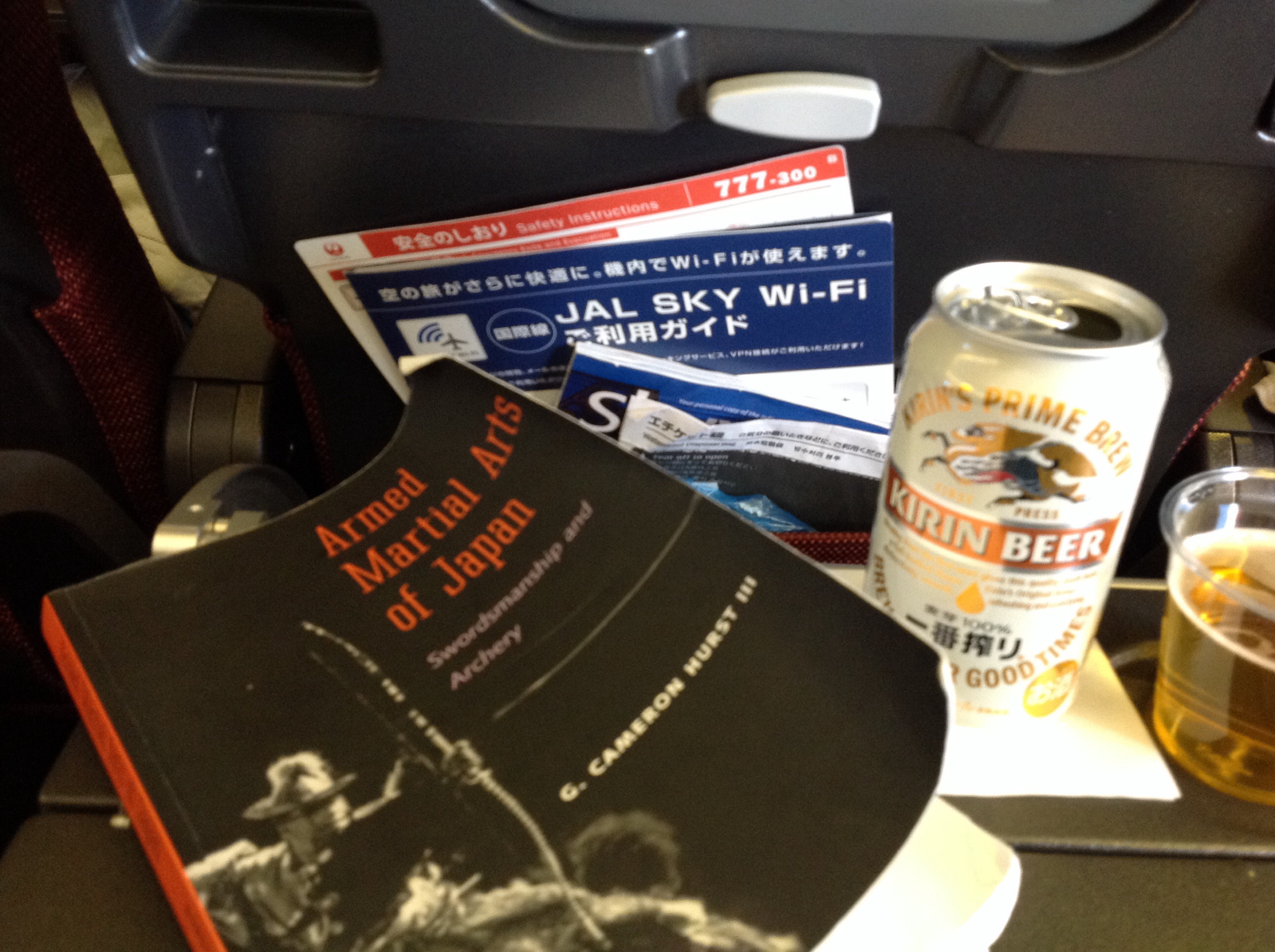
On JAL flight 772. Will be in Japan for five weeks. Lots of training planned as well travel. I will publish at least one post per day while I’m here.
Posted by David – 36号 逞毘道

On JAL flight 772. Will be in Japan for five weeks. Lots of training planned as well travel. I will publish at least one post per day while I’m here.
Posted by David – 36号 逞毘道
I often post a series of photos of Go-san and I practicing a part of a Taisha-ryu kata here in Sydney, but I never post a series showing an entire kata because members of the different keikokai (study groups) are not to teach or demonstrate Taisha-ryu.
The reason for this is not because Taisha-ryu wants to keep all of it’s techniques secret, but because members who have not reached the high rank of shinhandai are not deemed skilled enough to demonstrate or teach correctly.
If you’d like to see some done correctly in their entirety, here’s a video someone took in Osaka last year of Yamamoto-sensei and Sato-shihandai demonstrating some Taisha-ryu kata
Posted by David -36号 逞毘道
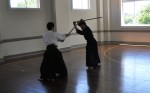
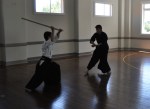
Today in the dojo.
Notice how Go-san is able to stay in a low kamae pretty much throughout this series of photos of part of a kata while I’m not. I’m going to Yastushiro in March. Have to be much better by then.


Posted by David -36号 逞毘道
Today in the garden.
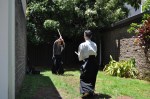
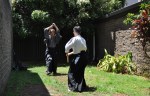




Still a long way to go…
Posted by David-36号 逞毘道
A friend of ours named John who lives in a 100 year old mock castle built by his grandfather on one of Sydney’s Northern Beaches invited Tsunoda-san, Shinko and I to come up and see some of his collection of Japanese swords. Tsunoda-san was very impressed with the castle – but didn’t have much to say about the swords. Anyway, it was interesting way for him to spend the last day of his trip to Sydney.




Posted by David-36号 逞毘道
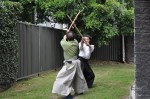
Today, Go-san and I were again fortunate to have Tsunoda-san who is visiting from Japan help us with Taisha-ryu kumidachi.
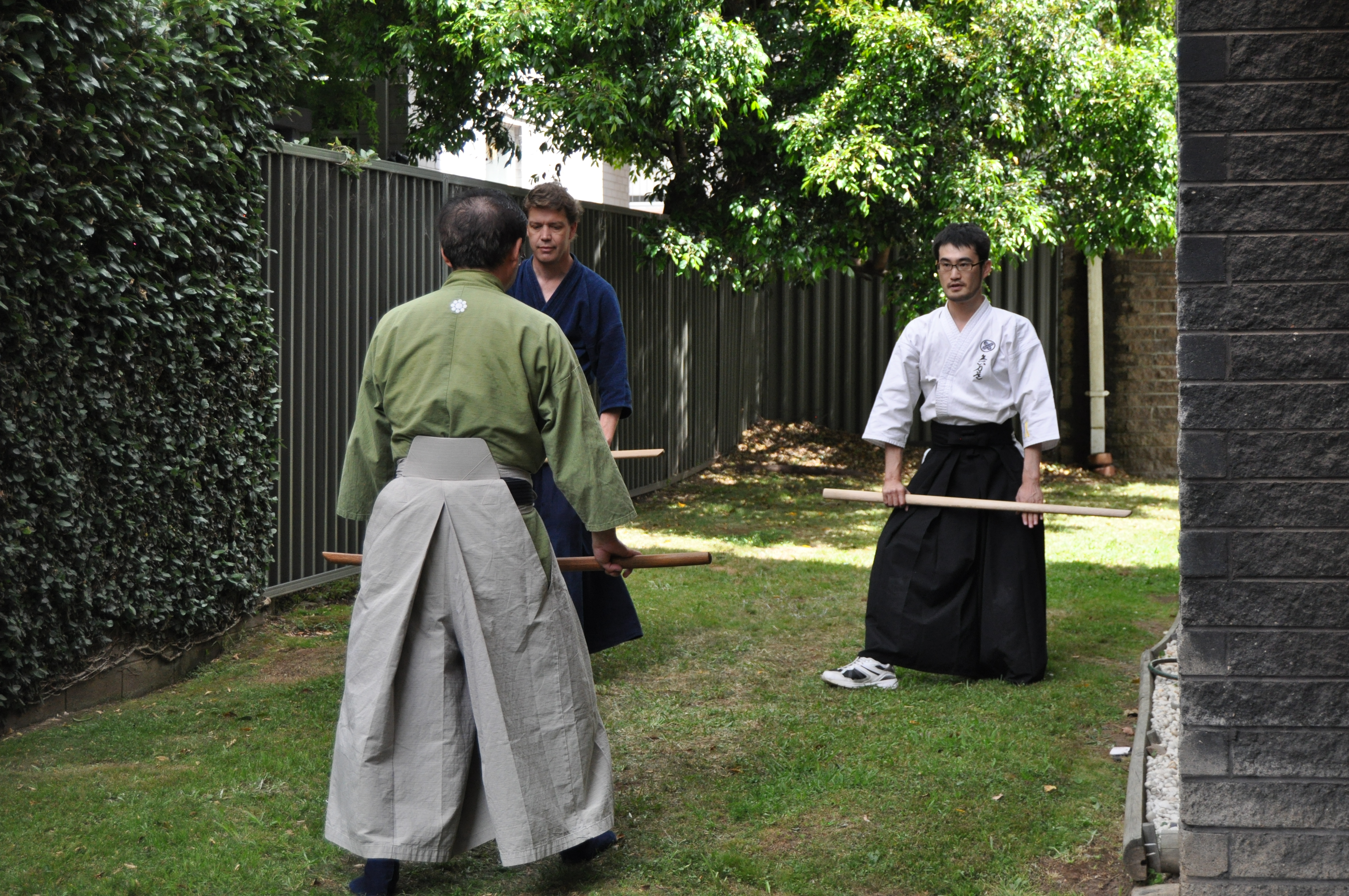



Posted by David36
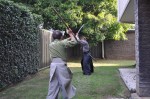
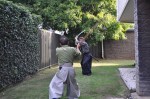
Today in the dojo. Tsunoda-san from the Taisha-ryu Dojo Ryu-Sen-Kan in Yatsushiro is staying with me for a few days and took the time to help me with my still poor technique.
今日の道場。八代の龍泉館道場から兄弟子の角田さんが来豪、稽古をつけて頂きました。



Posted By David-36号 逞毘道
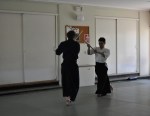
Today in the dojo – off balance, bad timing, and still not capable of moving in the correct (low) kamae .
Go-san and I have trained together for thirteen years in Eishin-ryu, Nakamura/Toyama-ryu and Mushintodo.
In March/April 2014 we joined the Taisha-ryu and are thus in a way starting all over again.




Posted by: David– 36号 逞毘道
There are, or once were, hundreds of ryu-ha (styles or schools) of kenjutsu in Japan, most of which are descended from only three that were created during the sengoku-jidai (age of a country at war): The Shinto-ryu – founded c.1450, the Kage-ryu – founded c. 1490 and the Itto-ryu – founded c.late 1500’s.
The first and oldest of the three is the Shinto-ryu – full name: Tenshin Shoden Katori Shinto-ryu (天真正伝香神道流) founded by Iizasa Yamashiro no kami Choisai (1387-1488)* and is still in existence.
The second, the Kage-ryu (陰流) which Kamiizumi Ise no Kami Nobutsuna mastered and from which he created his own version which he called the Shinkage-ryu (新陰流)meaning New Kage-ryu from which many well known ryu-ha sprang including the Yagyu-Shinkage-ryu as well as our style, the Taisha-ryu, was created by Aisu Ikkosai (1452-1538).
Aisu Ikkosai was from Ise province and is said to have been a pirate as well as a trader whose business/piracy saw him travelling to many parts of Japan and as far away as China where coastal towns were raided by Japanese pirates known as wakou (倭寇ーわこう). Not much is known for certain, but somehow, perhaps he was taught ,or maybe through trial and error on the job he became an adept swordsman but like many masters of his time he sought a deeper understanding of the nature of the sword and looked for divine revelation.
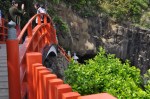
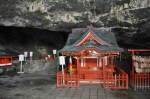
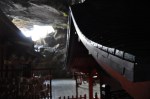
At the age of 36, in 1488, he came to the remote Udo Jingu in the province of Hyuga on the East coast of Kyushu to seek guidance from the gods. The shrine, located on the beautiful Nichinan coast, is in a cave battered by wave after wave from the ocean, and it was here that in a dream the kami appeared to him in the form of a monkey and imparted the secrets of the warrior arts with which he created the Kage-ryu.
When in Kyushu, Udo Jingu is one of many places in Miyazaki Prefecture worth a visit.
Click on photos to enlarge.
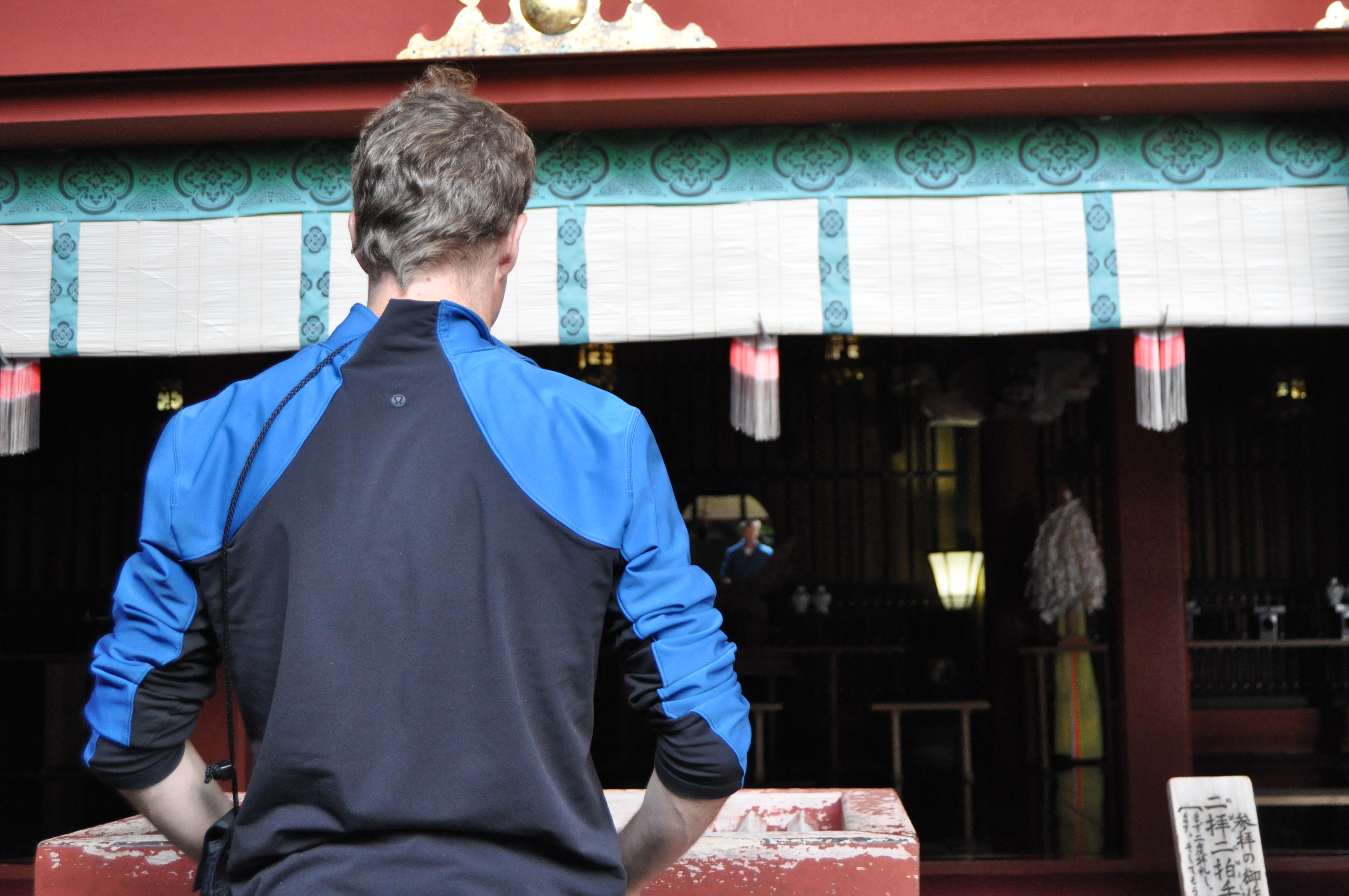
When you stand before the alter inside the cave at Udo Jingu you see your reflection in the holy kagami (mirror) looking back at you.



*No, that’s not a typo. He lived to be over 100 years old.
Sources and further reading:
Hurst, G. Cameron, III. Armed Martial Arts of Japan, Yale University Press, 1998
Friday, Karl F. The Kashima-shinryu and Samurai Martial Culture, University of Hawaii Press, 1997
Posted by David – 36号 逞毘道
Here is a trailer for the first ever documentary about the Taisha-ryu with English subtitles.
 Taisha-ryu Kenjutsu study group Australia